22 October, 2026
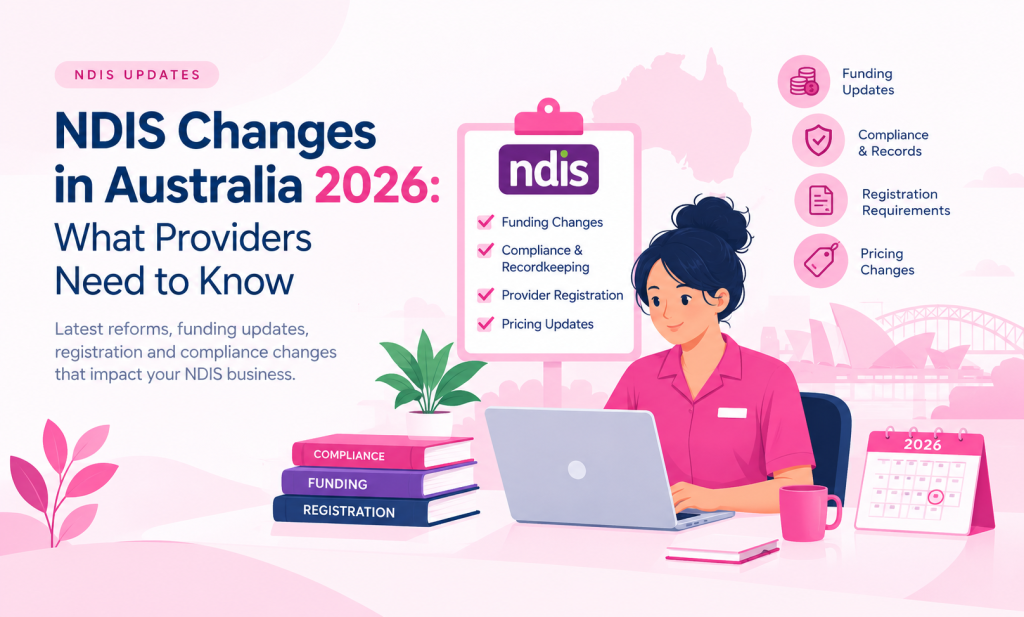
NDIS Changes in Australia 2026: What Providers Need to Know
Feature Update
12 min read
Introduction
The Australian National Disability Insurance Scheme (NDIS) is entering an important period of change. New legislation, updates to participant funding, stronger compliance requirements and changes to provider registration are reshaping how disability support services operate across the country.
For NDIS providers, support coordinators and Supported Independent Living (SIL) services, keeping up with these developments is becoming increasingly important. Providers need to understand how regulatory changes may affect their operations, manage staff schedules efficiently, maintain accurate records and continue delivering reliable support to participants.
In October 2026, several significant developments deserve attention. These include changes to participant support budgets, new requirements for plan reassessments, the expansion of provider registration requirements and updates to NDIS pricing arrangements.
Understanding these changes can help providers prepare for upcoming obligations and improve their day-to-day operations.
In this article, we explore the latest NDIS updates in Australia, explain what they mean for providers and highlight practical steps businesses can take to prepare.
1. Major NDIS Reforms in Australia: What’s Changing in 2026?
One of the biggest developments this year is the introduction of the National Disability Insurance Scheme Amendment (Securing the NDIS for Future Generations) Act 2026.
The legislation received Royal Assent on 20 August 2026. It introduces changes intended to strengthen the scheme’s long-term sustainability, improve oversight and address fraud and non-compliance.
The reforms cover several areas, including:
- Eligibility requirements for accessing the NDIS.
- How participant plans and funding are managed.
- Rules governing funded supports.
- Provider registration and regulatory oversight.
- Recordkeeping, compliance and fraud prevention.
Not every change applies immediately. Some measures have already commenced, while others will be introduced progressively over the coming years.
For providers, this means compliance should be treated as an ongoing responsibility rather than a one-time administrative task.
Businesses should regularly review official NDIS announcements, assess how new requirements apply to their services and update their internal processes accordingly.
What providers should do: Review current operating procedures, keep relevant records organised and establish a process for monitoring regulatory updates.
Official source: NDIS — Securing the NDIS for Future Generations.
2. NDIS Participant Support Budgets Are Changing From October 2026
A significant development for participants and providers is the phased adjustment of certain NDIS support budgets.
From 1 October 2026, changes to funding for some supports began as new plans were approved or existing plans were reassessed. The adjustments affect two broad areas:
- Social, economic and community participation.
- Improved daily living skills.
The changes will be introduced progressively over 12 months. For plans renewed from 1 February 2027, the relevant changes will apply through the renewal process.
Importantly, the impact will vary depending on each participant’s plan, circumstances and support needs. Not every support category is affected.
The Australian Government has identified several areas that will not be affected by these particular budget reductions, including employment supports, disability-related health supports and certain high-intensity and complex supports.
Essential day-to-day assistance, such as support with eating, dressing, toileting and household tasks, is also among the supports identified as unaffected by these specific reductions.
Providers should avoid assuming that every participant will experience the same funding changes.
What does this mean for NDIS providers?
Providers may need to review service arrangements as participants’ plans are reassessed or renewed.
Practical steps include:
- Reviewing participant service agreements and scheduled supports.
- Communicating with participants and their representatives about relevant changes.
- Monitoring approved budgets and service delivery arrangements.
- Reviewing staff rosters when confirmed support requirements change.
- Keeping accurate records of delivered services and related administration.
Good communication is particularly important when a participant’s available funding or approved supports change.
Providers should confirm the details of each participant’s plan rather than making assumptions based on general announcements.
Official source: NDIS — Changes to Support Budgets From 1 October.
3. Stronger NDIS Provider Compliance and Recordkeeping Requirements
Another important trend in 2026 is the increased focus on transparency, recordkeeping and compliance across the NDIS.
Under measures that commenced in August 2026, providers face strengthened regulatory oversight and new record-retention requirements. The published reform timeline specifies that providers must retain relevant records for seven years, while participants and plan managers must retain their relevant records for three years.
These requirements make reliable documentation an essential part of running an NDIS business.
Providers need to ensure their records accurately reflect the supports delivered, the associated claims and other relevant information required under applicable rules.
Depending on the service, important records may include:
- Staff rosters and shift allocations.
- Timesheets and attendance records.
- Service delivery documentation.
- Participant service agreements.
- Relevant invoices and claim records.
- Staff qualifications and screening documentation, where applicable.
Maintaining accurate records can help providers respond to audits, investigate discrepancies and demonstrate that their services are being delivered appropriately.
However, maintaining records alone does not guarantee compliance. Providers must also follow the specific requirements that apply to their registration status, support categories and operations.
How can providers improve recordkeeping?
A consistent documentation process can reduce the risk of missing information.
Providers should establish clear responsibilities for updating records, checking timesheets, reviewing service delivery information and securely storing business documents.
Digital systems can also help bring operational information together, making it easier for authorised team members to access relevant records.
For growing providers, standardised processes are particularly valuable because information becomes harder to manage as staff numbers and participant schedules increase.
4. Mandatory Registration Requirements Are Expanding
Provider registration is another important area of change in the Australian disability support market.
From 1 July 2026, new providers seeking to deliver Supported Independent Living (SIL) supports or operate as NDIS digital platform providers must be registered under the applicable requirements.
Existing unregistered SIL providers were required to apply for registration by 1 October 2026 or stop providing SIL services. Providers refused registration must cease providing those services.
These changes form part of a broader effort to strengthen oversight of higher-risk supports and improve accountability.
The government has also outlined plans to expand mandatory registration requirements further, including to additional high-risk supports from July 2027.
Providers should check the latest official guidance to establish which requirements apply to their particular services and circumstances.
Why does this matter for SIL providers?
Registration involves more than submitting an application. Applicable requirements can include demonstrating suitability to deliver supports, meeting relevant quality standards, satisfying worker screening obligations and complying with ongoing reporting requirements.
Providers should assess their current position and identify any outstanding requirements.
Practical preparation may include:
- Reviewing registration obligations and applicable deadlines.
- Checking staff screening and qualification records.
- Documenting internal procedures.
- Reviewing service delivery and recordkeeping processes.
- Assigning responsibility for monitoring compliance updates.
Businesses considering expansion into SIL services should also understand the registration requirements before commencing operations.
Important: Registration obligations differ according to the type of support and provider circumstances. Always confirm current requirements with the NDIS Quality and Safeguards Commission.
Official source: NDIS — Mandatory Registration and SIL Provider Updates.
5. NDIS Pricing Updates: What Providers Should Watch
NDIS pricing arrangements are also evolving.
On 24 September 2026, the Australian Government announced new price limits for NDIS supports for the 2026–27 period. The determination followed changes to the statutory arrangements governing NDIS pricing.
In addition, the government has been consulting disability stakeholders on differentiated pricing, which could adjust the price of supports depending on whether they are delivered by registered or unregistered providers.
The NDIS Annual Pricing Review for 2026–27 recommended that differentiated pricing begin on 1 January 2027. However, this should not be interpreted as confirmation that every proposed arrangement will automatically take effect on that date.
Providers should monitor official announcements for final decisions and implementation details.
What should providers review?
Pricing changes can affect business planning, service agreements and financial forecasting.
Providers should:
- Review the current NDIS Pricing Arrangements and Price Limits.
- Check applicable price limits before quoting or claiming.
- Review service agreements when relevant pricing changes occur.
- Monitor announcements about differentiated pricing.
- Keep invoices and claim records accurate.
- Assess how operating costs affect service delivery.
Providers should not assume that a general pricing update means every support item has changed.
Checking the specific support item and applicable pricing rules is essential.
Official source: Australian Government — New Price Limits Set for NDIS Supports.
6. Why Efficient Rostering Matters More Than Ever
As the NDIS market changes, providers need reliable operational processes to manage staff, participants and scheduled supports.
Rostering is particularly important for organisations coordinating multiple workers, participant appointments, community access activities and daily support requirements.
When schedules are managed manually across spreadsheets, messages and separate documents, it can become difficult to maintain a clear overview of daily operations.
Common challenges include:
- Staff availability and shift allocation.
- Last-minute roster changes.
- Scheduling conflicts.
- Incomplete shift records.
- Time-consuming administrative work.
- Limited visibility across teams.
These challenges can become more difficult as a business grows or regulatory requirements evolve.
Using suitable NDIS rostering software can help providers organise scheduling information and reduce reliance on disconnected manual processes.
For example, a centralised rostering system can help teams manage shifts, access relevant staff information and keep operational details organised.
The right system depends on the provider’s size, workflows, support types and compliance requirements. Software should support good operational practices rather than replace the provider’s responsibility to meet its legal obligations.
7. How RotaWiz Can Help NDIS Providers Manage Daily Operations
RotaWiz provides rostering software designed for Australia’s NDIS community.
For providers looking to organise their day-to-day operations, a centralised rostering system can make it easier to coordinate shifts and manage staff information.
RotaWiz offers tools to support tasks such as:
Staff rostering: Organise shifts and maintain a clearer overview of scheduled work.
Staff information management: Keep relevant staff details accessible within your rostering workflow.
Operational visibility: Help teams stay informed about scheduling information and changes.
Reduced manual administration: Bring rostering activities into a more organised process instead of relying entirely on disconnected spreadsheets and messages.
These capabilities can be useful for small NDIS providers, independent support workers and growing disability support businesses that want a more structured approach to rostering.
Technology is only one part of effective NDIS operations. Providers must still maintain appropriate records, follow applicable pricing rules, meet registration obligations and ensure participants receive the supports they are entitled to.
By combining reliable systems with clear internal processes, providers can build a stronger operational foundation.
Want to simplify your team’s rostering? Explore RotaWiz NDIS Rostering Software and discover how a more organised approach can support your daily operations.
8. What NDIS Providers Should Prepare for Next
The latest reforms highlight the importance of staying informed and maintaining flexible operational processes.
Providers should focus on several practical priorities over the coming months.
Stay updated on regulatory changes. Monitor announcements from the NDIA, the Department of Health, Disability and Ageing, and the NDIS Quality and Safeguards Commission.
Review participant plans and service arrangements. Understand the specific funding and support requirements relevant to each participant.
Strengthen documentation practices. Maintain accurate records and establish processes for meeting applicable record-retention obligations.
Check registration requirements. Confirm whether your services fall within existing or upcoming mandatory registration categories.
Review pricing arrangements. Check current price limits and follow announcements about proposed changes.
Improve operational efficiency. Review how your organisation manages staff rosters, shift changes and service delivery information.
Preparing early can help providers identify potential issues before they affect day-to-day operations.
Conclusion
The NDIS landscape in Australia is changing, with 2026 bringing important developments in participant funding, provider registration, pricing and compliance.
For NDIS providers, the priority is to understand which changes apply to their services and prepare their businesses accordingly. Accurate records, clear communication, appropriate registration and efficient operational processes will remain important as further reforms are introduced.
At the same time, providers should look for practical ways to manage their daily responsibilities without creating unnecessary administrative complexity.
RotaWiz helps Australia’s NDIS community manage rostering through a more organised digital workflow. By combining appropriate technology with strong operational practices, providers can improve visibility across their teams and focus on delivering reliable support to participants.
Explore RotaWiz today and take a more organised approach to NDIS rostering.
Frequently Asked Questions
Q 1. What are the latest NDIS changes in Australia in 2026?
Major developments include changes to certain participant support budgets, stronger compliance and recordkeeping requirements, expanded provider registration obligations and updated pricing arrangements. The timing and impact vary depending on the specific reform.
Q 2. Are NDIS participant budgets changing in October 2026?
Yes. Certain budgets relating to social, economic and community participation and improved daily living skills are being adjusted progressively as plans are reassessed or renewed. The effect depends on each participant’s circumstances and applicable plan arrangements.
Q 3. What are the new NDIS recordkeeping requirements for providers?
Under the reforms that commenced in August 2026, providers must retain relevant records for seven years. Providers should check the official guidance to understand which records they must keep and how the requirements apply to their services.
Q 4. Do SIL providers need to register with the NDIS?
Mandatory registration requirements apply to SIL providers under the 2026 changes. Existing unregistered SIL providers were required to apply by 1 October 2026 or stop providing SIL services. Providers should consult the NDIS Quality and Safeguards Commission for current requirements.
Q 5. How can NDIS rostering software help providers?
NDIS rostering software can help providers organise staff schedules, manage shift information and reduce manual administration. The benefits depend on the software’s features and how the provider uses it.
Q 6. Where can providers find official NDIS updates?
Providers can monitor the official NDIS news page, the Australian Government’s NDIS reform updates and the NDIS Quality and Safeguards Commission for authoritative information.