26 May, 2026
SCHADS Award Disability Support Worker: The Complete 2025–26 Guide for NDIS Providers in Australia
Feature Update
10 min read
If you run an NDIS business in Australia, few things carry more legal and financial weight than the SCHADS Award. The Social, Community, Home Care and Disability Services Industry Award (MA000100) sets the minimum wages, penalty rates, allowances, and working conditions for disability support workers right across the country – and getting it wrong can mean back-pay liability, Fair Work penalties, and serious reputational damage.
From 1 July 2025, SCHADS minimum pay rates increased by 3.5% following the Fair Work Commission’s Annual Wage Review. For many providers, this also raised new questions: Are our rosters still compliant? Are we paying the correct penalty rates for weekend and evening shifts? Are our NDIS billing rates still aligned?
This guide answers all of that – and shows you how modern NDIS rostering software like RotaWiz can automate SCHADS compliance so you never have to calculate penalty rates by hand again.
What Is the SCHADS Award?
The Social, Community, Home Care and Disability Services Industry Award (SCHADS Award) is a national minimum employment standard administered by the Fair Work Commission and enforced by the Fair Work Ombudsman. It covers employees working in:
- Disability support services (including NDIS-funded supports)
- Community and social services
- Home care and aged care
- Crisis accommodation
- Family day care
For NDIS providers across Australia – whether you’re based in Sydney, Melbourne, Brisbane, Perth, or regional areas – the SCHADS Award is the legal baseline for how your support workers must be paid and treated.
Important: The SCHADS Award applies to employees. If you engage independent contractors, different rules apply. Always seek advice from Fair Work or a workplace relations specialist if unsure.
SCHADS Award Pay Rates 2025–26: Disability Support Worker Levels Explained
Disability support workers under the SCHADS Award are classified by level (1 to 4 in most cases for direct support roles) and pay point within each level. Your classification depends on your duties, qualifications, and level of supervision.
Level 1 – Entry-Level Support Worker
Level 1 covers workers who are new to the disability sector, providing basic personal and community support under direct supervision. Most are working towards or have completed a Certificate III in Individual Support (Disability).
Approximate 2025–26 full-time/part-time base hourly rates:
- Level 1.1: ~$31.50/hr
- Level 1.2: ~$32.30/hr
- Level 1.3: ~$33.10/hr
Casual loading of 25% applies on top of these rates.
Level 2 – Experienced Support Worker
Level 2 workers provide hands-on support – often with complex or high-needs participants – and typically hold a Certificate III or have equivalent experience.
Approximate 2025–26 base hourly rates:
- Level 2.1: ~$34.00/hr
- Level 2.2: ~$35.00/hr
- Level 2.3: ~$36.00/hr
- Level 2.4: ~$38.00/hr
In 2025, Level 2 disability support workers in Australia earn between approximately $34 and $38 per hour depending on pay point and employment type.
Level 3 – Advanced/Specialist Support Worker
Level 3 workers typically hold a Certificate IV or higher, take on more complex cases, and may provide mentoring or work with limited supervision.
Approximate 2025–26 base hourly rates:
- Level 3.1: ~$38.65/hr
- Level 3.2: ~$39.77/hr
- Level 3.4: ~$41.45/hr
Level 4 – Senior Disability Support Worker / Team Leader
Level 4 covers senior support workers, team leaders, and others with specialised skills who are responsible for guiding other staff and managing complex participant needs.
Note: Always verify your specific rates against the current Fair Work Ombudsman SCHADS Pay Guide before processing payroll. Rates shown above are indicative for the 2025–26 financial year.
SCHADS Penalty Rates: What NDIS Providers Must Know
One of the most common (and costly) compliance mistakes NDIS providers make is applying incorrect penalty rates. The SCHADS Award includes mandatory penalty rate multipliers for shifts outside ordinary weekday hours.
| Shift Type | Penalty Rate |
|---|---|
| Monday–Friday (ordinary hours) | 100% (base rate) |
| Saturday | 150% of base rate |
| Sunday | 175% of base rate |
| Public Holidays | 225% of base rate (min. 3 hrs) |
| Evening shifts (after 8pm weekdays) | 115% of base rate |
| Casual loading | +25% on all rates |
Example: A Level 2.1 casual support worker ($34/hr base + 25% = ~$42.50/hr) working a Sunday shift earns approximately $74.38/hr (175% x $42.50).
This is why manual rostering and spreadsheets are so dangerous – a single miscalculation across multiple workers compounds into significant payroll underpayment.
Key SCHADS Award Allowances for Disability Support Workers
Beyond base and penalty rates, disability support workers may also be entitled to allowances under the SCHADS Award:
Sleepover Allowance If your support worker is required to sleep at a client’s home or worksite, they must be paid a sleepover allowance. This is separate from their ordinary hourly rate.
Kilometre/Travel Allowance Workers who use their own vehicle to travel between clients are entitled to a per-kilometre vehicle allowance. Providers must ensure workers keep a travel log and that this is reflected in payroll.
Broken Shift Allowance When a disability support worker works a broken shift (two separate periods of work in a day), they may be entitled to a broken shift allowance under the SCHADS Award.
First Aid Allowance Workers who hold a current first aid certificate and are required to use those skills may attract an additional first aid allowance.
SCHADS Award vs NDIS Price Limits: Understanding the Difference
This is one of the most frequently confused topics for NDIS providers in Australia.
The SCHADS Award sets the minimum you must pay your workers as their employer. The NDIS Price Limits set the maximum you can charge participants for delivering supports – and these billing caps are higher than award wages because they are designed to cover on-costs like superannuation, leave, overheads, and organisational margin.
For the 2025–26 financial year, the standard NDIS daytime support worker price cap is approximately $70.23/hr nationally for core supports delivered on weekdays. This contrasts with a typical SCHADS Level 2 base rate of ~$34–$38/hr, illustrating the operational cost structure providers must manage carefully.
Self-managed NDIS participants are not bound by NDIA price caps, but SCHADS Award wages still apply to all employees regardless of funding type.
Why SCHADS Compliance Is So Hard to Manage Manually
If you’re managing your disability support worker rosters through spreadsheets, text messages, or generic scheduling tools, you already know the headaches:
- Incorrect penalty rates – Did Saturday’s rate automatically update? Did you remember the public holiday loading?
- Missed allowances – Sleepover shifts, broken shifts, and travel costs are easy to overlook manually.
- Award interpretation errors – The SCHADS Award has multiple streams, levels, and pay points. One wrong assumption leads to underpayment.
- Audit trail gaps – The Fair Work Ombudsman requires you to maintain records for at least 7 years. Manual systems rarely produce clean audit-ready records.
- Pay rises go unnoticed – The annual July wage review catches many providers off guard.
With over 325,000 workers supporting NDIS participants across Australia – and a further 128,000 expected to be needed as the sector grows – the volume of rosters, shifts, and pay calculations NDIS providers must manage is only going up.
How RotaWiz Automates SCHADS Award Compliance for NDIS Providers
This is where RotaWiz changes the game for Australian disability support providers.
RotaWiz is a purpose-built, cloud-based NDIS rostering platform designed specifically for Australian providers – and it has SCHADS award compliance built into its core. Here’s what that means in practice:
Automatic SCHADS Award Interpretation
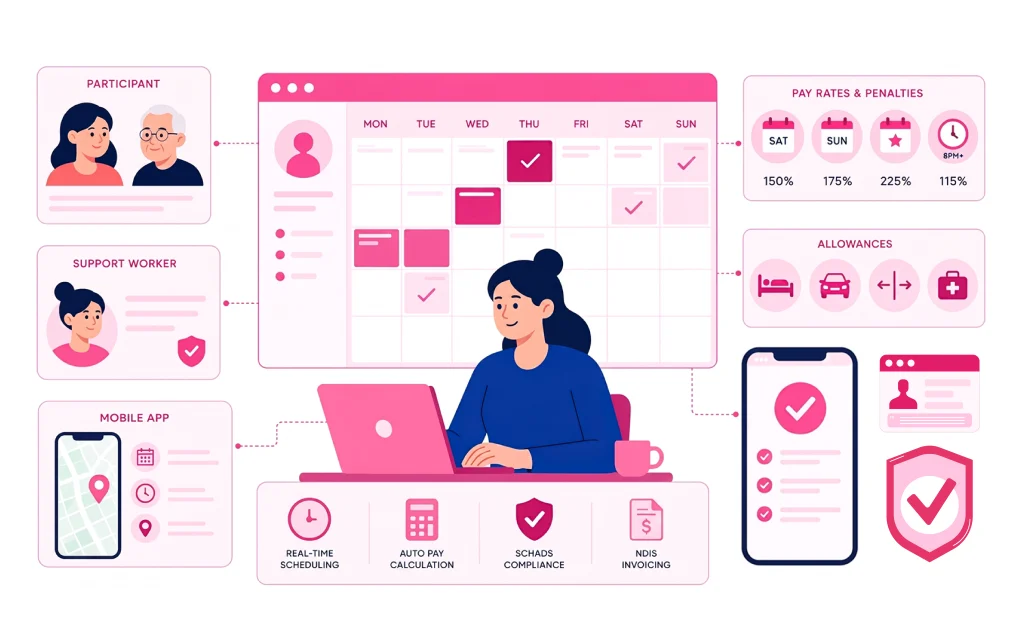
Every roster you build in RotaWiz is automatically checked against SCHADS Award rules. Weekday, Saturday, Sunday, public holiday, evening shift, sleepover, casual loading – the system applies the correct rate without you needing to look it up.
Real-Time Shift Management with Compliance Visibility
No more double-bookings, missed shifts, or mismatched worker-to-participant assignments. RotaWiz gives coordinators a live dashboard showing active shifts, compliance status, and worker credentials – all in one place.
NDIS-Aligned Invoicing and Budget Tracking
Once a shift is completed, RotaWiz generates compliant invoices aligned to the current NDIS price guide – bridging the gap between what you pay workers under SCHADS and what you bill participants or plan managers under NDIS pricing rules.
Mobile App for Support Workers
Support workers access their schedules, shift notes, and incident reporting through RotaWiz’s dedicated mobile app (iOS and Android). GPS-verified clock-in/clock-out removes disputes about hours worked and feeds directly into timesheet records.
Audit-Ready Documentation
Every shift is documented, timestamped, and stored in a format ready for NDIS quality and safeguards audits. Shift notes can be logged via speech-to-text using preset NDIS-compliant templates.
Free Forever Plan for Small Providers
RotaWiz offers a free forever plan for up to 5 users – making enterprise-grade SCHADS compliance tools accessible to small and startup NDIS providers, independent support workers, and allied health practitioners who previously couldn’t afford dedicated software.
Common SCHADS Award Mistakes NDIS Providers Make (and How to Avoid Them)
- Misclassifying workers at Level 1 when they should be Level 2+ Always match the worker’s actual duties and qualifications to the correct SCHADS level. Misclassification leads to underpayment and potential Fair Work action.
- Not updating pay rates on 1 July each year The Fair Work Commission’s annual wage review takes effect on 1 July. Providers who don’t update payroll systems immediately risk underpaying staff from day one of the new financial year.
- Forgetting to pay sleepovers and broken shift allowances These are legally required entitlements. Failing to pay them – even unknowingly – constitutes underpayment under the SCHADS Award.
- Applying the wrong award entirely Some providers incorrectly classify disability support workers under the Home Care Award rather than the SCHADS Award. Industry bodies like the Australian Services Union note this can be a red flag.
- Not maintaining records for 7 years The Fair Work Ombudsman requires payroll records, timesheets, and pay slips to be retained for a minimum of 7 years. Ensure your rostering and payroll system produces and stores compliant records automatically.
SCHADS Award 2025–26: Key Changes Summary
| Change | Detail |
|---|---|
| Wage increase | 3.5% increase effective 1 July 2025 |
| New aged care worker structure from January 2025 | |
| Superannuation | Employer contributions increased to 12% from 1 July 2025 |
| Annual review | Next review expected July 2026 |
Frequently Asked Questions (FAQs)
Q: What is the SCHADS Award for disability support workers? The SCHADS Award (MA000100) is the national minimum employment standard for disability support workers in Australia, covering pay rates, penalty rates, allowances, and working conditions.
Q: How much does a disability support worker earn under SCHADS in 2025? Pay depends on level and pay point. Entry-level (Level 1) workers earn approximately $31–$33/hr base, while experienced workers at Level 3 can earn $38–$41/hr. Casual loading of 25% applies on top of these base rates.
Q: Do NDIS providers have to follow the SCHADS Award? Yes. All NDIS providers employing support workers in Australia must comply with the SCHADS Award at minimum, unless their Enterprise Agreement (EA) provides better overall conditions.
Q: What penalty rates apply on weekends under SCHADS? Saturday shifts attract 150% of the base rate, and Sunday shifts attract 175% of the base rate. Public holiday shifts attract 225%, with a minimum 3-hour engagement.
Q: How can rostering software help with SCHADS compliance? Modern NDIS rostering platforms like RotaWiz automatically apply SCHADS pay rates, penalty multipliers, and allowances to every shift – eliminating manual errors and generating audit-ready records.
Q: What is the difference between SCHADS Award rates and NDIS price limits? SCHADS Award rates are the minimum you must pay your workers. NDIS price limits are the maximum you can charge participants, and are set higher to account for on-costs like superannuation, leave, and organisational overheads.
Stay Compliant and Roster Smarter in 2025
The SCHADS Award is not optional – and staying on top of annual pay increases, penalty rates, allowances, and classification rules is an ongoing operational challenge for every NDIS provider in Australia.
The good news? You don’t have to manage it alone.
RotaWiz is built by Australians, for Australian NDIS providers. It takes the complexity out of SCHADS compliance by automating the calculations that eat up your time and create the most compliance risk – leaving you free to focus on delivering exceptional support to your participants.
Ready to simplify your SCHADS compliance? Start free with RotaWiz today → – no credit card required, free forever for up to 5 users.