If you’ve just received your first NDIS plan, or you’re preparing for a review, you’ll quickly encounter a question that stumps many participants: how should your funding be managed? It sounds like an administrative detail, but the choice you make will affect which providers you can use, how much flexibility you have, and how much administrative work lands on your shoulders.
At RotaWiz, we support participants through this decision every week. This guide explains the options using real data, honest comparisons, and our direct experience as a registered NDIS provider.
The Scale of the NDIS in 2026: Why This Decision Matters
Before diving into management types, it helps to understand the scale of the scheme you’re navigating.
761,442: Australians benefiting from the NDIS as of February 2026
$22.9B: Total NDIS Scheme expenses in just the 6 months to December 2024
$19.3B: Projected savings from 2026 reforms over 4 years to June 2028
These numbers matter because the 2026 reforms, designed to stabilise scheme growth, directly affect how plans are structured and funded. Choosing the right management type puts you in the best position to navigate this changing landscape.
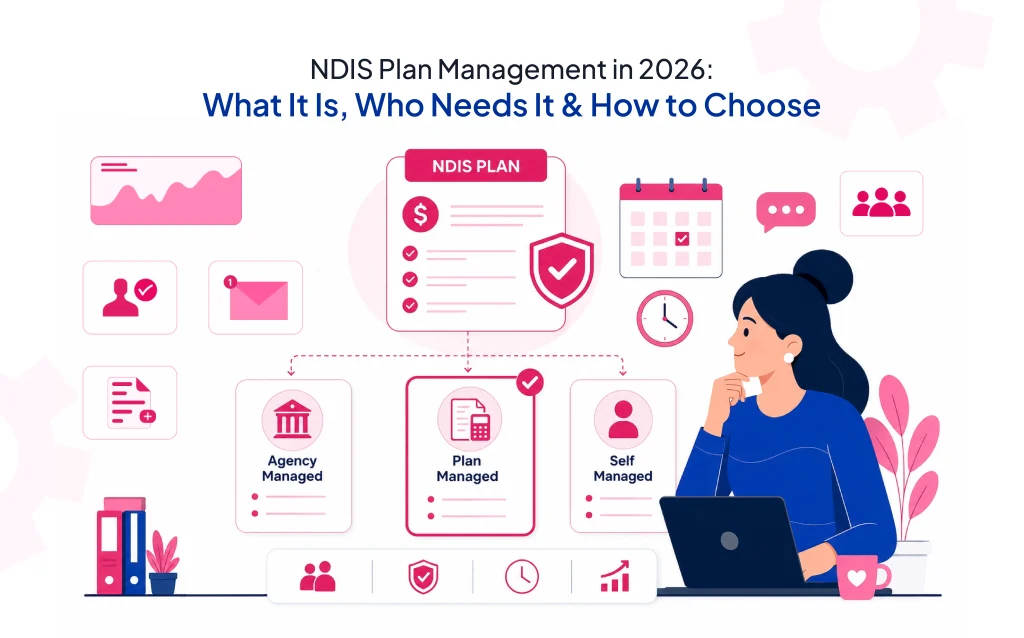
The 3 Types of NDIS Plan Management
NDIS software offers three ways to manage your funding. Each has real trade-offs, there is no universally ‘best’ option.
- Agency-Managed (NDIA-Managed)
The National Disability Insurance Agency pays your registered providers directly. You don’t touch invoices or budgets. The trade-off: you can only use NDIS-registered providers, which limits your choices significantly, particularly in regional or specialist areas where registered providers are scarce.
- Plan-Managed
A registered Plan Manager handles all invoices, payments, and budget tracking on your behalf. You keep the flexibility to use both registered and unregistered providers, a significant advantage. Plan management itself is funded separately in your NDIS plan, so it costs you nothing from your supports budget.
This is currently the most popular option for participants who want flexibility without the administrative burden of self-management.
- Self-Managed
You control everything, paying providers directly, keeping financial records, and lodging claims through the NDIS portal. This gives you maximum choice and flexibility (you can even hire workers directly), but requires time, financial literacy, and organisational capacity.
What Does a Plan Manager Actually Do?
Many participants assume plan management is just ‘paying bills’. In practice, a good plan manager does significantly more:
- Receives, verifies, and pays invoices from your support providers, usually within 5 business days
- Tracks your budget in real time across all support categories
- Sends you regular statements (monthly at minimum) so you always know your balances
- Flags overspending risk before it becomes a crisis, not after
- Manages NDIS portal compliance to ensure payments meet NDIA requirements
- Advises you when the 2026 pricing or reform changes affect your specific plan
A plan manager doesn’t decide what supports you receive, that’s the NDIA’s job during your planning meeting. Their role is purely financial stewardship of what’s already been approved.
The 2026 NDIS Reforms: What’s Changing for Plan Management
The Australian Government’s Securing the NDIS for Future Generations reforms, with the Bill introduced to Parliament in May 2026, bring meaningful change for plan-managed participants:
8%: Annual NDIS growth target the NDIA is aiming to reach by 2026–27 (down from 22% in recent years)
- New National Framework Plans launch from July 1, 2026 for adult participants, changing how plans are structured and how budgets are allocated
- Funding periods introduced: plans now release funds quarterly (after May 2025) rather than as a lump sum, plan managers must adapt their tracking accordingly
- Budget adjustments for social, civic, and community participation supports from October 1, 2026, plan managers need to communicate these changes proactively
- From July 2025, all Support Coordinators must be NDIS-registered, this also raises the bar for plan management accountability
At RotaWiz, we’ve updated our plan management processes to align with all current and upcoming reforms. If you’re uncertain how these changes affect your plan, our team can review your situation at no obligation.
How to Choose a Plan Manager: 5 Questions That Matter
Not all plan managers provide the same level of service. Here are the questions we recommend asking before you sign any service agreement:
- Are you registered with the NDIS Quality and Safeguards Commission?
All plan managers must be registered. Ask for their registration ID and verify it at ndiscommission.gov.au. - How do you track and report my budget?
Look for real-time participant portals, not just monthly PDF statements. Delays in budget reporting are one of the most common complaints from participants. - What is your average turnaround time for paying invoices?
Best practice is 3–5 business days. Delays cause providers to withhold services, which affects your supports. - Do you have experience with my disability type or support needs?
A plan manager who understands complex needs (e.g., psychosocial disability, high-care SIL) will catch issues that a generalist won’t. - What happens if I’m unhappy with your service?
You have the right to change plan managers at any time. A good plan manager will tell you this upfront, not in the fine print.
Common Plan Management Mistakes, And How to Avoid Them
- Not reviewing monthly statements until the budget has run out, check your balance at least fortnightly
- Assuming plan management is the same across all providers, quality varies enormously
- Failing to notify your plan manager when your support needs change mid-plan, this creates budget mismatches
- Choosing based on price alone, plan management is funded separately and at a standard rate, so ‘cheaper’ usually means fewer services, not a better deal
RotaWiz Plan Management: Our Commitment to Participants
As a registered NDIS provider, RotaWiz offers plan management backed by real disability expertise, not just financial processing. Our participants have a named plan manager, real-time budget access, and proactive communication about how 2026 reforms affect their specific plan.
We currently support participants across a range of disability types, including physical, intellectual, psychosocial, and sensory disabilities, and our team is trained to navigate complex, multi-support plans.
If you’d like to explore whether RotaWiz is the right plan manager for you, reach out for a free, no-obligation consultation. There’s no paperwork required to start the conversation.