
6 October, 2026
SIL Provider Management: How Better Rostering Can Simplify Supported Independent Living
Feature Update
9 min read
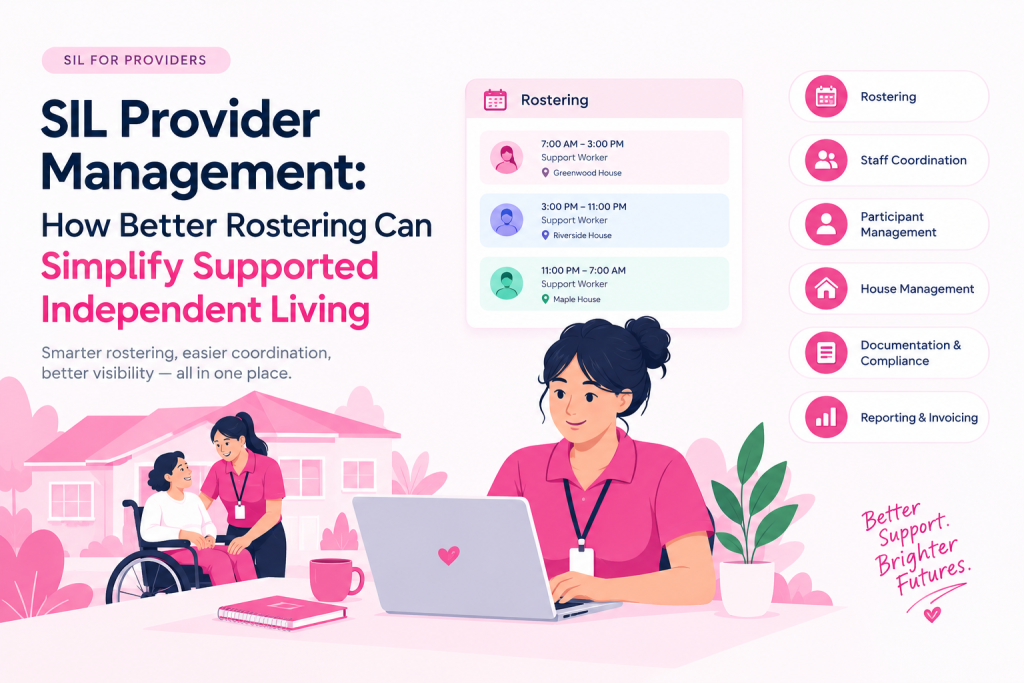
Running a Supported Independent Living (SIL) service is about much more than filling shifts on a calendar.
Every day, SIL providers coordinate participants, support workers, homes, schedules, documentation, staff availability, incidents, medication records and changing support needs. When all of this information lives across spreadsheets, messages, emails and separate systems, even a small change can create hours of extra administration.
That is where the right SIL provider management software can make a real difference.
Instead of constantly chasing updates and checking multiple systems, providers can bring rostering, participant information, staff coordination and operational records into one connected workflow.
For NDIS SIL providers, the goal is simple: spend less time managing paperwork and more time creating consistent, participant-focused support.
What Makes SIL Rostering Different?
Supported Independent Living often involves shared homes where multiple participants may receive support from the same team of workers.
This creates a different level of rostering complexity.
A provider may need to consider:
- Which staff members are available?
- Which participant needs support at a particular time?
- Is the right support ratio being used?
- Which worker is assigned to each home?
- Are there overlapping shifts?
- What happens when a staff member calls in sick?
- Which participants are currently living in each property?
- Are important documents and records up to date?
- How will changes be communicated to the team?
When these decisions are managed manually, mistakes become easier to make.
A dedicated SIL rostering software solution can bring these moving parts together, giving managers a clearer view of homes, participants, workers and shifts.
The Hidden Cost of Managing SIL Rosters Manually
Spreadsheets can be useful when a provider is starting out. But as the number of participants, homes and support workers grows, spreadsheets can quickly become difficult to maintain.
Imagine a staff member becomes unavailable for tomorrow’s overnight shift.
The manager may need to:
- Check the roster.
- Find another available worker.
- Check their availability.
- Confirm the participant’s support requirements.
- Update the shift.
- Notify the worker.
- Inform the relevant team members.
- Update another spreadsheet or system.
- Check whether the change affects other shifts.
One small change can turn into a long administrative process.
Now imagine managing this across several SIL homes.
This is why modern NDIS rostering software for SIL providers is becoming an important operational tool. A connected system can help teams make changes faster while keeping everyone working from the same information.
One Clear View Across Your SIL Homes
Managing one property is challenging enough. Managing multiple SIL homes can quickly become complicated.
Each home may have different participants, support requirements, staff teams, schedules and documentation.
Without centralised visibility, managers can spend a significant amount of time moving between records just to understand what is happening.
A good SIL management system should make it easier to see:
- Each SIL home
- Current participants
- Assigned support workers
- Staff availability
- Upcoming shifts
- Vacancies and staffing requirements
- Important documents
- Compliance information
- Incidents and updates
- House-level operational information
RotaWiz is designed around this approach. Providers can manage SIL homes, participants, staff and operational information through a central system instead of relying on disconnected records.
That visibility can make everyday decisions much easier.
Smarter Rostering for Shared Supports
One of the biggest challenges for SIL providers is managing shared support arrangements.
A shift may involve multiple participants and support workers, which means the roster needs to accurately reflect who is receiving support and who is providing it.
RotaWiz supports shared shift creation, participant and staff linking, facility-based coordination and ratio-based rostering. Its SIL functionality is designed to help providers manage shared supports while maintaining clearer operational visibility.
Instead of building every shift from scratch, providers can also use recurring roster templates for regular schedules.
That matters because SIL operations often involve recurring routines.
The same staff member may work at the same home every Tuesday. A participant may have regular support requirements. A home may follow a predictable weekly schedule.
Why recreate the same information manually every week?
A better system lets providers build repeatable processes and spend their time on the changes that actually require attention.
Staff Coordination Should Not Depend on Guesswork
Your roster is only useful if your staff can access the right information.
Support workers need to know where they are working, when their shift starts, which participants they are supporting and whether anything has changed.
Managers, meanwhile, need confidence that the right people are assigned to the right shifts.
RotaWiz provides staff coordination features that help providers assign teams to homes or shifts, keep calendars synchronised and communicate operational updates.
This can create a much smoother workflow between managers and support workers.
Instead of relying on multiple messages to communicate every change, teams can work from a shared source of information.
Participant Information Should Stay Connected
SIL management is not only about staff schedules.
Participants are at the centre of the service.
Their information, support requirements, communication records and relevant documents need to remain accessible to the people responsible for their support.
When participant information is scattered across different files, it becomes harder for teams to maintain a complete picture.
RotaWiz allows providers to connect participants, staff and relevant documents while maintaining central visibility across SIL homes. Providers can also maintain participant care plans and communication logs within the platform.
This connected approach helps teams move away from fragmented administration.
Keep Important SIL Documentation Organised
Documentation is another area where manual processes can become overwhelming.
SIL providers may need to manage records relating to:
- House operations
- Safety checks
- Incidents
- Participant information
- Medication records
- Staff information
- Maintenance
- Daily notes
- Communication
- Compliance
When these records are stored across different folders and systems, finding the right information can take time.
RotaWiz provides functionality for storing shared compliance and safety documents, connecting incidents to houses and participants, managing eMAR and medication logs at the house level, and recording daily notes, safety checks and maintenance updates.
The benefit is not simply having more digital records.
It is having those records connected to the people, homes and activities they relate to.
What Happens When a Participant Is Absent?
SIL operations can change quickly.
A participant may be away from the home. A worker may become unavailable. A shift may need to be changed at short notice.
These changes can affect staffing, attendance, scheduling and billing.
A well-designed system should help providers respond without rebuilding the entire roster.
RotaWiz’s SIL functionality includes attendance tracking and dynamic adjustments for shared shifts. When a participant is absent, the system can recalculate cost splits based on active participants.
This kind of automation can reduce unnecessary manual calculations and give administrators more confidence in their records.
From Rostering to Billing: Connect the Workflow
One of the biggest advantages of connected SIL software is that rostering does not have to exist in isolation.
A shift can flow through several stages:
Plan → Assign → Deliver → Track → Approve → Invoice
When these processes are disconnected, staff may need to enter the same information multiple times.
That creates more work and increases the possibility of errors.
RotaWiz connects approved SIL shifts with invoicing and supports ratio-based cost allocation for shared supports. Providers can generate detailed invoices from approved shifts, helping create a more connected operational workflow.
For growing providers, this can be especially valuable because better processes become more important as the number of participants and homes increases.
Use Data to Understand Your SIL Operations
Good management is not only about knowing what is happening today.
It is also about understanding patterns over time.
Which homes require more staffing?
Where are roster changes happening frequently?
Are incidents increasing?
How efficiently are resources being used?
Are occupancy and budgets tracking as expected?
RotaWiz provides reporting and analytics capabilities that can help SIL providers monitor areas such as staffing and roster variance, incident trends, occupancy, utilisation and budget efficiency.
These insights can help managers make decisions based on operational information rather than assumptions.
Technology Should Support Better Care, Not Replace It
It is easy to think of software as simply an administrative tool.
But for SIL providers, better administration can have a direct impact on the support experience.
When managers spend less time searching through spreadsheets, chasing confirmations and manually updating multiple systems, they have more time to focus on their teams and participants.
When workers receive clearer schedules, they can prepare for their shifts.
When information is easier to access, teams can communicate more effectively.
And when records are organised, providers can spend less time trying to reconstruct what happened.
Technology does not replace person-centred support.
It creates the structure that helps teams deliver it consistently.
What Should SIL Providers Look for in Software?
If you are considering an SIL management or rostering platform, do not choose based on the number of features alone.
Look for software that fits the way your organisation actually operates.
Key areas to consider include:
1. SIL Rostering
Can you manage individual and shared shifts easily?
2. Staff Management
Can you see availability, assignments and team information in one place?
3. Participant Management
Can participant information and relevant records remain connected to their support?
4. House Management
Can you manage multiple SIL properties without creating separate spreadsheets for every home?
5. Compliance and Documentation
Can your team securely manage important operational records and documentation?
6. Attendance and Timesheets
Can staff hours be recorded, reviewed and approved efficiently?
7. Billing and Invoicing
Can approved shifts flow into accurate invoicing?
8. Reporting
Can managers understand staffing, occupancy, incidents and operational performance?
9. Ease of Use
Most importantly, can your team actually use the system without unnecessary complexity?
The best system is not necessarily the one with the longest feature list.
It is the one that makes everyday work easier.
Why RotaWiz Can Be a Practical Choice for SIL Providers
RotaWiz brings SIL rostering, participant management, staff coordination, documentation, attendance, reporting and operational visibility into a connected platform.
Providers can manage individual homes and participants while maintaining a broader view of their organisation. The platform also supports shared shifts, ratio management, facility coordination and billing workflows for SIL operations.
That means your team can spend less time jumping between disconnected tools and more time managing the work that matters.
Whether you are managing one SIL home or growing across multiple properties, having a structured system can make everyday operations easier to control.
Make SIL Management Simpler
Supported Independent Living comes with real operational complexity.
There are people to support, homes to manage, staff to coordinate, shifts to organise and records to maintain. As your organisation grows, managing all of this manually becomes harder to sustain.
The answer is not necessarily more spreadsheets, more messages or more administration.
It is a better-connected workflow.
With the right SIL provider software, you can bring rostering, staff coordination, participant information, house management, documentation, attendance, reporting and invoicing closer together.
And when the operational side runs more smoothly, your team can focus on what matters most:
delivering consistent, participant-centred support.
Ready to simplify your SIL operations?
Explore how RotaWiz can help you manage your SIL homes, participants, staff and rosters from one connected platform.
Start your free RotaWiz account and see how simpler SIL management can look.


Related Stories for You


How Small NDIS Providers Can Reduce Admin and Manage Growth
September 15, 2026