15 September, 2026
How Small NDIS Providers Can Reduce Admin and Manage Growth
Feature Update
9 min read
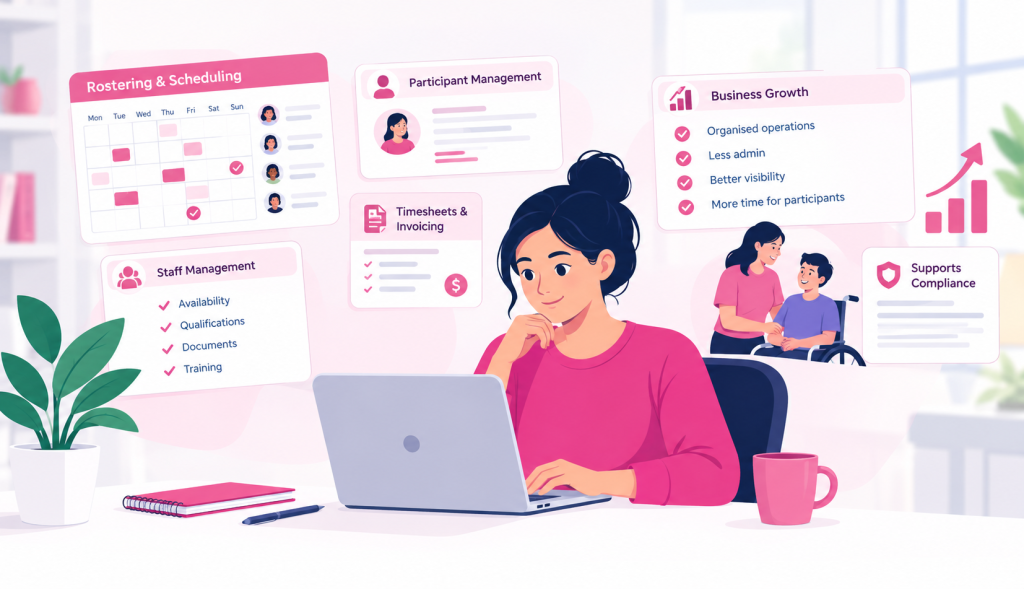
Running a small NDIS provider business often means doing many jobs at once.
You may be responsible for managing participants, organising support workers, building rosters, checking timesheets, responding to staff, maintaining records, preparing invoices and keeping your business organised.
When your provider business is small, spreadsheets, calendars, emails and messaging apps may seem manageable. But as you take on more participants and workers, the same processes can quickly become difficult to maintain.
A missed roster update can create a scheduling problem. A worker’s availability can change at short notice. Participant information may need to be updated across multiple files. Administrative tasks can start taking time away from the work that matters most: delivering quality support.
This is why having the right systems in place early can make a significant difference for small NDIS providers.
Why Administration Becomes Difficult for Small NDIS Providers
Small providers often have fewer administrative resources than larger organisations.
An owner or manager may be responsible for several operational tasks at the same time. Instead of having separate teams for rostering, workforce management, participant administration and billing, these responsibilities may sit with one or two people.
As the business grows, the amount of information that needs to be managed also grows.
For example, you may need to keep track of:
- Participant details and support requirements
- Worker availability
- Staff schedules and recurring shifts
- Shift changes and cancellations
- Timesheets and hours worked
- Worker qualifications and documents
- Participant notes and service records
- Invoices and billing information
- Internal policies and operational records
- Communication between administrators and support workers
Managing all of this manually can create unnecessary administrative work.
The NDIS Practice Standards also recognise that provider governance and operational systems should be appropriate to the size, scale and complexity of the provider. Quality management, record keeping and workforce management are important parts of operating an NDIS provider business.
The goal is not to create more administration. It is to build systems that make everyday administration easier to manage.
1. Start With a Reliable NDIS Roster
For many small providers, rostering is one of the first operational areas that becomes complicated.
A roster is not simply a list of workers and times. You may need to consider participant requirements, worker availability, recurring services, leave, cancellations and last-minute changes.
When rosters are managed through spreadsheets or separate calendars, every change may require multiple manual updates.
A dedicated NDIS rostering software system can bring these activities into one place.
A good rostering system should make it easier to:
- Create recurring shifts
- View upcoming schedules
- Check worker availability
- Identify scheduling conflicts
- Update shifts quickly
- Keep administrators and workers informed
- Maintain a clearer record of scheduled services
For a small provider, this can reduce the amount of time spent manually coordinating schedules.
2. Reduce the Number of Systems You Use
Using different tools for every part of the business can create another problem: information becomes scattered.
You might use one spreadsheet for staff availability, another for participant information, email for communication, a calendar for rosters and separate software for invoicing.
Each tool may work individually, but managing information between them can become time-consuming.
This is where NDIS provider management software can help.
Instead of repeatedly moving information between different systems, a connected platform can bring key operational information together.
For a small provider, fewer disconnected systems can mean:
- Less duplicate data entry
- Fewer spreadsheets to maintain
- Easier access to operational information
- Better visibility of day-to-day activities
- Less time spent searching for information
The right software does not need to make your business more complicated. Ideally, it should remove unnecessary steps.
3. Keep Staff Information Organised
Your support workers are central to your service delivery, but workforce administration can quickly become difficult as your team grows.
You may need to keep track of availability, qualifications, documents, training and other worker information.
The NDIS Practice Standards include human resource management requirements around worker qualifications, experience, induction, training, supervision and maintaining relevant worker records.
For small providers, having a structured system for managing workforce information can make these responsibilities easier to monitor.
Instead of searching through folders, emails and spreadsheets, your team can have a more organised way to access worker information.
This is particularly useful when you need to check whether a worker is suitable and available for a particular shift.
4. Make Participant Information Easier to Manage
Participant information should be easy for authorised team members to access when they need it.
As your provider business grows, participant details can become spread across documents, spreadsheets, emails and other systems.
A centralised system can help organise information such as participant profiles, service details, goals, notes and other operational information.
The benefit is not simply having more data. It is having the right information available in a structured way.
For small providers, this can make everyday coordination easier and reduce the need to repeatedly search through different files.
5. Reduce Manual Timesheet and Billing Work
Another common administrative challenge is making sure scheduled services, hours worked and billing information are properly aligned.
When timesheets are managed manually, administrators may need to compare multiple records before preparing invoices.
This can take time and create opportunities for errors.
Connecting rostering, timesheets and billing workflows can help create a clearer operational process.
For example:
Roster → Shift → Timesheet → Approval → Invoice
When these activities are connected, administrators have less information to transfer manually between systems.
This does not remove the need for proper review and financial processes, but it can make the workflow easier to manage.
6. Build Systems Before Your Business Gets Bigger
One of the biggest mistakes a small NDIS provider can make is waiting until administration becomes overwhelming before improving its processes.
It is easier to establish good systems while the business is still manageable than to rebuild everything after the team has grown.
Think about what happens when you move from:
5 workers → 15 workers → 30 workers
The number of schedules, availability changes, records and administrative tasks can increase significantly.
A process that works for five workers may become inefficient for thirty.
That is why small providers should think about scalability when choosing NDIS software Australia.
The right platform should support your current needs without making it difficult to expand later.
7. Look for Software That Is Simple to Use
Small providers do not necessarily need the most complicated software.
They need software that solves real operational problems without creating another layer of administration.
When comparing software for NDIS providers, consider questions such as:
- Can I manage rosters easily?
- Can I manage recurring shifts?
- Can I see staff availability?
- Can I keep participant information organised?
- Can I manage timesheets?
- Can I keep important worker information accessible?
- Can I manage billing or invoicing workflows?
- Can my team use it without extensive training?
- Can the system grow with my provider business?
- Can I access important information when working remotely?
The best solution is not necessarily the one with the longest feature list.
It is the one that fits the way your business actually operates.
8. Choose a System That Supports Compliance — Not Just Administration
Software cannot make an NDIS provider compliant by itself.
Compliance depends on your policies, processes, people, training, documentation and how your organisation delivers services.
However, good operational software can help create more structured processes and make important information easier to manage.
The NDIS Quality and Safeguards Commission states that providers need systems relevant and proportionate to their size, scale and the complexity of the supports they deliver. Its Practice Standards also cover areas such as governance, quality management, human resources, risk management, complaints and incident management.
This is particularly important for smaller providers.
You do not need to build a large corporate structure to operate professionally. You need practical systems that support your responsibilities and make your operations easier to manage.
9. Give Your Team Better Visibility
Good administration is not only about saving time.
It is also about visibility.
When managers can quickly see upcoming shifts, worker availability, participant information and operational activity, they can make decisions more confidently.
For example, if a support worker becomes unavailable, an organised rostering system can make it easier to identify the affected shift and determine what needs to happen next.
Better visibility can also help reduce unnecessary back-and-forth communication.
Instead of asking several people for information that already exists somewhere in a spreadsheet or message thread, your team can work from a more central source of operational information.
10. When Should a Small NDIS Provider Consider Software?
There is no single number of participants or workers that means you must adopt software.
However, there are some clear warning signs.
You may benefit from dedicated NDIS software if:
- You are spending too much time creating rosters manually.
- Staff availability is becoming difficult to track.
- You regularly update several spreadsheets.
- You are repeating the same information in different systems.
- Shift changes are difficult to communicate.
- Timesheet checking takes too long.
- Participant information is becoming difficult to organise.
- You are relying heavily on emails or messaging apps for operational coordination.
- Your business is growing and your current processes are becoming harder to manage.
If several of these situations sound familiar, it may be time to review your current systems.
How RotaWiz Helps Small NDIS Providers
RotaWiz is designed to help small and growing NDIS providers manage everyday operations in one structured platform.
Instead of relying on separate tools for rostering, staff information, participant management, timesheets and other operational tasks, providers can manage key workflows from one system.
RotaWiz supports areas including:
- NDIS rostering and scheduling
- Recurring shifts
- Staff availability
- Participant management
- Timesheets
- Worker information and credential tracking
- Notes and operational records
- Billing and invoicing workflows
- Mobile access for teams
For smaller providers, the focus is on reducing unnecessary administrative work without introducing a complicated system.
The aim is simple: give providers better visibility of their operations so they can spend less time managing spreadsheets and more time focusing on their participants and team.
Final Thoughts
Running a small NDIS provider business comes with enough responsibilities without adding unnecessary administration.
As your provider business grows, manual spreadsheets, separate calendars and disconnected tools can become difficult to maintain.
A structured NDIS provider management system can help you organise rostering, staff information, participant records, timesheets and other operational workflows in a more efficient way.
The important thing is to choose software based on your real needs.
Look for a system that is easy to use, supports your current operations, provides useful visibility and can grow with your business.
For small NDIS providers, better systems are not about adding more technology.
They are about creating a simpler way to run the business.
Ready to simplify your NDIS operations? Explore RotaWiz for small NDIS providers and see how you can manage your roster, team and day-to-day operations from one place.


Related Stories for You