The NDIS sector is entering a new phase. Growth is no longer the biggest challenge, but sustainability and a good organisational system are. Providers are expanding, participant needs are becoming more complex, and regulatory expectations are tightening. As 2026 approaches, one truth is becoming unavoidable: good intentions and quality care alone are not enough to run a resilient NDIS organisation.
What will separate providers who thrive from those who struggle is not how much they care but how well their systems support that care.
When we talk about “good systems” in the NDIS context, we’re not talking about more tools, more dashboards, or more features. We’re talking about NDIS provider systems that quietly hold everything together while the organisation grows, changes, and adapts.
Why “Good Systems” Are Becoming the New Competitive Advantage?
In earlier stages of the NDIS, many providers grew through effort and goodwill. Teams worked harder when things became messy. Admins stayed back late. Coordinators filled gaps manually. Care quality was protected by people compensating for process gaps.
That model doesn’t scale.
As providers prepare for NDIS provider 2026, operational complexity increases faster than headcount. More participants mean more shifts, more funding rules, more reporting, and more compliance risk. Without strong systems, growth creates fragility instead of stability.
Care Quality Still Matters, But It Can’t Carry the Business Alone
High-quality care will always be the foundation of the NDIS. Participants, families, and regulators expect it. But many providers are discovering that excellent care outcomes can still exist alongside operational stress, staff turnover, and financial leakage.
That’s because care delivery now sits inside a much larger ecosystem: funding alignment, shift management, workforce availability, compliance documentation, and communication across teams. When these elements are poorly connected, even the best carers are set up to fail.
Strong NDIS provider systems protect care quality by removing unnecessary friction around it. They ensure that carers spend their time supporting participants, not chasing information, correcting rosters, or dealing with last-minute chaos.
How Weak Systems Quietly Undermine Even Great Care?
One of the most common patterns across the sector is care teams compensating for weak systems. When rostering tools don’t reflect reality, staff adjust informally. When information is scattered, knowledge lives in people’s heads. When processes are unclear, experience fills the gaps.
This works until it doesn’t.
As organisations grow, these workarounds become invisible risks. Small inconsistencies turn into compliance issues. Manual fixes slow down response times. Key people become single points of failure. And eventually, the pressure shows up as burnout, missed shifts, or funding disputes.
This is exactly why conversations about NDIS compliance 2026 are increasingly linked to systems maturity. Compliance isn’t just about policies; it’s about whether daily operations consistently reflect them.
What “Good Systems” Actually Look Like in Practice?
Good systems don’t announce themselves loudly. They show up as calm operations, predictable outcomes, and confident teams.
At a practical level, effective NDIS provider systems share a few common characteristics:
- They connect workflows instead of isolating them
- They give real-time visibility into rostering and support delivery
- They reduce reliance on memory, experience, and manual checks
- They support decision-making with accurate operational data
What matters most is not sophistication, but alignment. Systems must reflect how care is actually delivered, how funding actually works, and how staff actually operate on the ground. When systems are designed for the realities of disability support and not generic workforce management, everything downstream becomes easier.
Why Rostering Has Become an Operational Backbone?
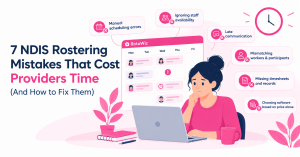
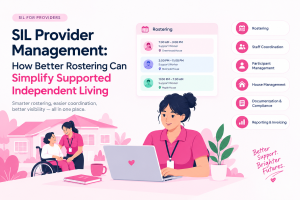
Rostering is no longer an administrative task. For most providers, it has become the operational backbone of the organisation.
Rosters determine how funding is used, how staff experience their work, and how consistently participants receive support. Poor rostering creates ripple effects across payroll, compliance, communication, and care continuity. Strong rostering, on the other hand, creates structure without rigidity.
As providers prepare for NDIS provider 2026, rostering must adapt faster than ever, which includes handling last-minute changes, complex support ratios, and evolving participant needs without breaking the system. This is where many legacy tools fall short.
How Providers Are Using RotaWiz to Strengthen Daily Execution?
Forward-thinking providers are increasingly relying on purpose-built NDIS rostering software like RotaWiz to support growth without losing control.
Rather than layering more features onto broken processes, they focus on execution, making sure the fundamentals work every day.
With RotaWiz, providers gain:
- Centralised rostering aligned with participant needs and funding
- Faster handling of last-minute changes without service disruption
- Clear visibility for admins, coordinators, and support workers
- Reduced manual follow-ups and duplicated effort
What makes this approach effective is clarity. RotaWiz is designed to fit naturally into how disability support organisations operate, making it easier for teams to stay compliant, responsive, and organised as they scale.
Compliance Pressure Is Rising. Systems Decide the Outcome
As regulatory expectations evolve, NDIS compliance in 2026 will place greater emphasis on consistency, documentation, and accountability.
Disconnected tools create gaps between policy and practice. Manual records increase risk. In contrast, integrated systems make compliance a by-product of normal operations rather than a separate burden.
Strong NDIS provider systems don’t add work for compliance. They reduce it by making it the right way with an easy and simple approach.
Workforce Stability Depends on Systems, Not Just Good Intentions
Staff retention is one of the biggest challenges facing the sector. While culture and leadership matter, day-to-day experience matters more. Predictable shifts, clear communication, and fair workload distribution all depend on operational systems.
When rostering is unreliable, staff lose trust. When changes aren’t communicated clearly, stress increases. Over time, even committed workers disengage.
Providers using well-aligned systems like RotaWiz are finding that operational clarity directly improves workforce stability.
Preparing for NDIS Provider 2026 Starts with Alignment
The providers best positioned for the future are not chasing every new tool or trend. They are aligning systems, workflows, and people around the realities of modern NDIS service delivery.
They understand that good systems don’t replace care; they protect it.
As an NDIS provider in 2026 looks for better systems, success will depend on whether operations can support growth without compromising quality, compliance, or staff well-being.
Conclusion
Being good at care will always matter, but it is no longer enough on its own. The next phase of the NDIS will reward providers who pair compassion with operational discipline.
“Good systems” are not about features or complexity. They are about creating stability, visibility, and confidence at every level of the organisation. With purpose-built solutions like RotaWiz, providers can strengthen their foundations today while preparing responsibly for what lies ahead.
The future of NDIS care isn’t just about doing more. It’s about doing it better, consistently, and sustainably.