Last updated: 26 August 2026
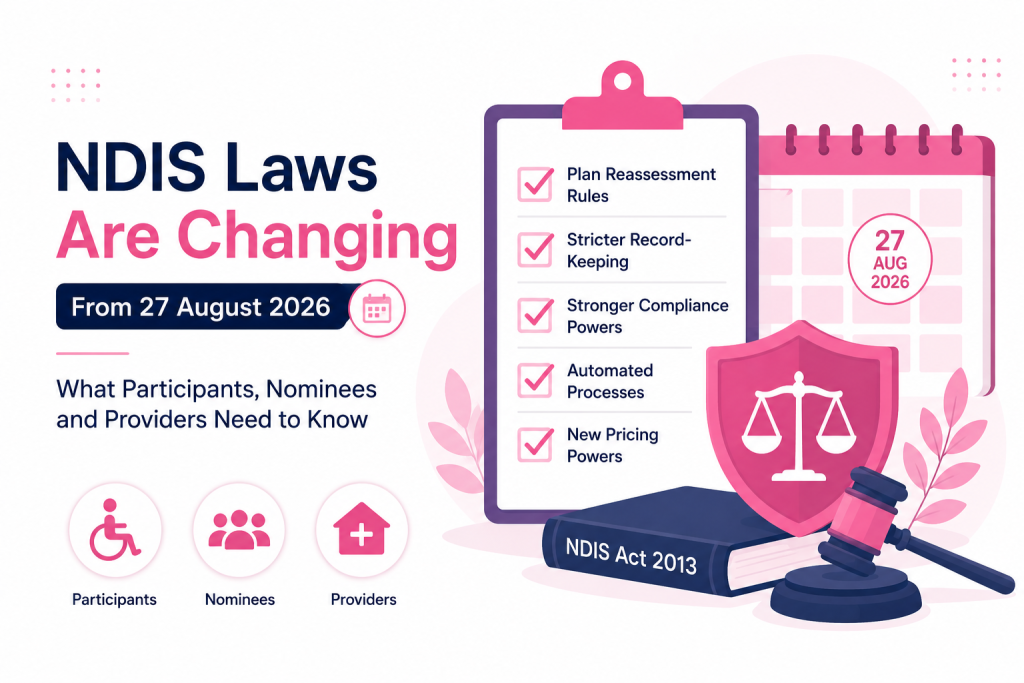
On 19 August 2026, the Australian Parliament passed the National Disability Insurance Scheme Amendment (Securing the NDIS for Future Generations) Bill 2026, one of the most significant updates to the NDIS Act 2013 since the Scheme began. The Governor-General signed the new laws the very next day, and the first wave of changes takes effect on 27 August 2026, with further reforms rolling out in stages through to 2028.
If you’re an NDIS participant, nominee, plan manager, or registered provider, this is the update you can’t afford to skim past. Below, we break down exactly what’s changing, when it happens, and what it means for you, based on the official information released by the NDIS and the Department of Health, Disability and Ageing.
Why This Reform Exists
This Bill is the third in a series of legislative changes responding to the Royal Commission into Violence, Abuse, Neglect and Exploitation of People with Disability, alongside the findings of the independent NDIS Review. The government’s stated aim is to make the Scheme “safer, clearer and more sustainable” while curbing unsustainable growth in NDIS expenditure, without cutting support for people with permanent and significant disability.
Whether you agree with every measure or not, the practical reality is that these changes are now law, and they will affect how plans are managed, how records are kept, and how compliance is enforced.
What Changes From 27 August 2026
1. Plan Reassessment Requests Are More Restricted
Previously, participants had more flexibility to request an early plan reassessment. Under the new rules, only participants, plan nominees, or child representatives can request one before the scheduled reassessment date, and only where there has been a significant and ongoing change to:
- Functional capacity or support needs, or
- Living, education, work, or informal support arrangements.
Once a request is lodged, the NDIA has 90 days to decide whether to proceed with a reassessment. If your situation doesn’t meet this threshold, you can still request a plan variation for short-term or urgent changes, that pathway hasn’t disappeared.
What this means for you: Don’t wait for a crisis to document changes in your circumstances. Keep clear, dated records of anything affecting your functional capacity or living situation, as this evidence will be central to any reassessment request.
2. Stricter Record-Keeping Requirements
The new law locks in minimum record retention periods:
- 3 years for participants
- 5 years for nominees
- 7 years for registered providers
This is designed to make sure claims and payments can be verified after the fact. Importantly, the NDIS has been clear that you may be required to repay funding if you can’t produce the records needed to show it was used correctly. This applies to invoices, service agreements, receipts, and anything else that proves a support was delivered and paid for appropriately.
What this means for you: If your record-keeping has been informal, now is the time to tighten it up, a simple digital folder system per financial year can save enormous stress down the line.
3. Stronger Compliance and Information-Gathering Powers
The NDIA now has enhanced powers to gather information and act on suspected fraud or non-compliance more quickly. Participants and providers may be required to supply information when requested, and civil penalties can now be issued to providers who fail to comply with certain obligations, such as providing requested information.
4. Automated Administrative Actions
Computer systems can now be used to process some administrative tasks, including certain claims and payments — automatically. The NDIS has stated that complex, discretionary, or judgement-based decisions will still be made by people, and it must publicly disclose where and how automation is used. Oversight and safeguards apply.
5. New Ministerial Pricing Powers
The Minister for Disability and the NDIS will gain the power to set maximum prices for NDIS supports through a formal pricing determination, informed by the NDIA’s Annual Pricing Review. There is no immediate change to current pricing, providers continue under existing arrangements for now.
What’s Coming Next (October 2026 Onwards)
This reform isn’t a single event, it’s a staged rollout. Some of the bigger changes on the horizon include
- October 2026: Support budgets for social, civic and community participation, and capacity-building supports, will be progressively reset as plans are reassessed. A new plan variation pathway will also be created for participants who need continuous 24-hour care. The NDIA will also gain the power to suspend plans if a participant doesn’t respond to information requests (after at least five documented contact attempts).
- December 2026: Claims must be submitted within 90 days of a support being delivered.
- February 2027: “Plan continuations” are replaced by “plan renewals” and unspent funds will no longer carry over between plans. New criteria for what counts as “reasonable and necessary” supports will also apply to new participants.
- 2027–2028: A new planning model, expanded mandatory provider registration, a panel of vetted plan management providers, and a new standardised eligibility assessment process for new applicants (with existing participants transitioned over three years).
What Should You Do Right Now?
- Participants and nominees: Review your current plan and reassessment date. If your needs have genuinely changed, start gathering supporting evidence now.
- Providers: Audit your record-keeping systems to ensure you can meet the 7-year retention requirement, and get familiar with the new compliance and civil penalty framework.
- Everyone: Bookmark the official NDIS page for this reform, as details are still being progressively updated by the agency.
The Bottom Line
This is the biggest structural update to NDIS law in years, and it’s being introduced in stages rather than all at once, which gives participants and providers a window to adapt before the more far-reaching changes (like the new eligibility assessment model) arrive in 2028. Staying informed early, rather than reacting after a plan reassessment or compliance check, will make this transition far smoother.
This article is general information only and does not constitute legal or financial advice. For guidance specific to your situation, contact the NDIA directly or speak with a qualified NDIS support coordinator or plan manager.
Official source: NDIS — Securing the NDIS for future generations