Running an NDIS business is about much more than delivering quality support.
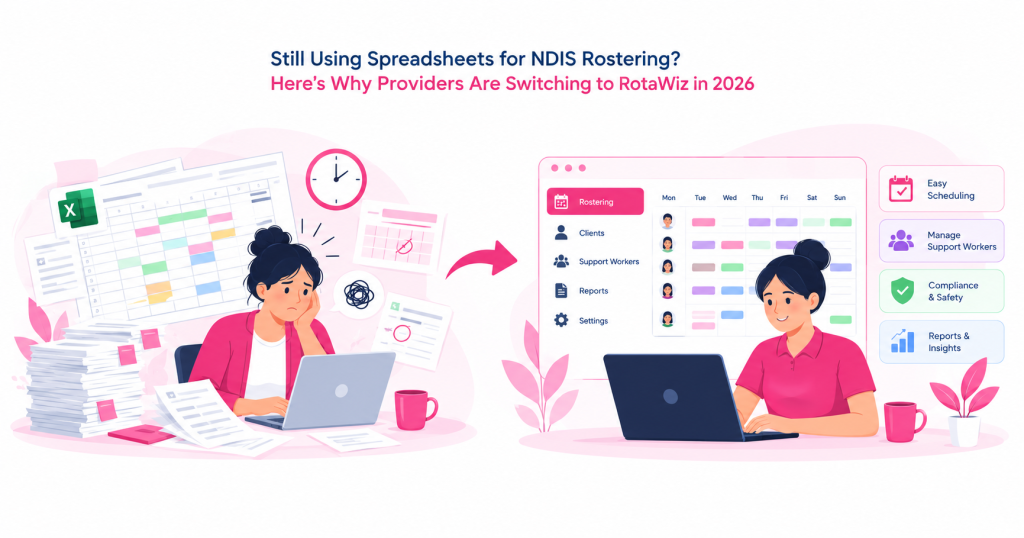
Every day, providers have to coordinate support workers, participants, shifts, availability, timesheets, notes, incidents, invoices, documents and compliance records. As the business grows, managing all of this through spreadsheets, emails, phone calls and messages can quickly become difficult.
A roster that looks simple on Monday can become completely different by Friday.
A worker calls in sick.
A participant changes their availability.
A shift needs to be reassigned.
A timesheet doesn’t match the roster.
An invoice needs checking.
A compliance document expires.
Suddenly, your team is spending more time managing administration than managing care.
This is one of the biggest reasons Australian NDIS providers are moving towards dedicated NDIS rostering software in 2026.
And the right platform doesn’t just help you create a roster. It can connect rostering, timesheets, client management, documentation, billing and workforce management into one workflow.
Why NDIS Rostering Is Becoming More Complex
For a small NDIS provider, creating a weekly roster may initially seem manageable with Excel or Google Sheets.
But as the number of participants and support workers increases, the number of moving parts increases too.
You may need to manage:
- Worker availability
- Participant schedules
- Recurring shifts
- Shift changes and cancellations
- Leave and unavailability
- Timesheets
- Travel and mileage
- Shift notes
- Incident records
- Client information
- Invoices and billing
- Staff documents
- Compliance requirements
- Communication with workers and participants
NDIS providers also need reliable records. The NDIS states that providers need to keep complete and accurate records of supports delivered, including records such as rosters, invoices, support logs, case notes and service agreements.
That means your roster isn’t simply an internal scheduling document.
It can form part of the wider operational record of the support your organisation delivers.
5 Problems With Managing NDIS Rosters in Spreadsheets
Spreadsheets aren’t necessarily bad. They can be useful when you’re starting out.
The problem starts when your business becomes dependent on them for everything.
1. Constant manual updates
One change can require multiple updates.
For example:
A support worker becomes unavailable for Tuesday’s 10 AM shift.
Someone needs to:
- Find the shift.
- Find an available worker.
- Update the spreadsheet.
- Notify the worker.
- Notify the relevant team member.
- Update any related records.
- Remember to update timesheets or billing information later.
A dedicated scheduling system can make this workflow much more structured.
2. Higher risk of scheduling mistakes
When several people are editing spreadsheets, mistakes become easier to make.
You may accidentally:
- Assign two workers to the same shift.
- Schedule a worker when they are unavailable.
- Leave a participant without coverage.
- Forget a roster change.
- Work from an outdated spreadsheet.
For an NDIS provider, these aren’t just administrative inconveniences. They can affect staff experience, participant continuity and operational efficiency.
3. Rosters and timesheets can become disconnected
One of the biggest problems with manual systems is the gap between:
What was scheduled
and
What actually happened.
A worker might be rostered from 9:00 AM to 1:00 PM but work different hours because of a change during the day.
If the roster, timesheet and invoicing processes are separate, your team may have to manually reconcile the information.
That creates unnecessary administrative work.
4. Important information gets spread across different tools
A typical provider might have:
Roster → Excel
Communication → WhatsApp
Documents → Google Drive
Timesheets → Another system
Invoices → Accounting software
Client notes → Another document
Incidents → Email
The problem isn’t necessarily any individual tool.
The problem is the fragmentation.
When information is spread across multiple systems, managers spend more time finding information and checking whether everything matches.
5. Growth becomes harder
A spreadsheet may work for a small team.
But what happens when you have:
- 10 workers?
- 25 workers?
- 50+ workers?
- Multiple participants?
- Multiple service locations?
- SIL services?
- Recurring shifts?
- Different types of support?
The bigger your operation becomes, the more important a structured workforce management system becomes.
What Should NDIS Rostering Software Actually Do?
Choosing software simply because it has a calendar isn’t enough.
A good NDIS rostering platform should help connect the entire workflow.
Here are some of the most important capabilities to look for.
Smart roster and shift management
You should be able to create, edit, assign and manage shifts without rebuilding your entire schedule every time something changes.
RotaWiz provides drag-and-drop rostering, recurring schedules, shift management and SIL rostering capabilities.
Worker availability
Your team should be able to manage staff availability and leave so managers can make better scheduling decisions.
Mobile access
Support workers aren’t sitting at a desk all day.
They need access to their shifts, timesheets and relevant information from their phones.
RotaWiz provides mobile functionality for administrators and carers, including shift management, clock-in/out, leave, mileage, shift notes and incident reporting.
Timesheets and attendance
Your software should make it easier to compare scheduled work with actual attendance.
RotaWiz includes GPS-verified clock-in and clock-out functionality, timesheet management and mileage tracking.
Client management
Your roster shouldn’t exist separately from your participant information.
A connected system can give managers better visibility of participants, plans, goals, funding and scheduled support.
Documentation and compliance records
Good record keeping is an important part of operating an NDIS business.
The NDIS specifically identifies rosters, support logs, case notes, invoices and service agreements among the records providers need to maintain.
A system that keeps operational information organised can make it easier for your team to maintain consistent records.
Don’t Forget About SCHADS Award Requirements
For many disability support providers, rostering also needs to take workplace requirements into account.
The Social, Community, Home Care and Disability Services Industry Award (SCHADS Award) includes rules covering hours of work, rostering, breaks, overtime, shiftwork and other employment conditions.
There were also changes to SCHADS sleepover arrangements taking effect from the first full pay period starting on or after 1 June 2026.
This is an important reminder:
Your rostering process shouldn’t only ask, “Who is available?”
It should also consider whether the proposed schedule works within the applicable employment rules and your organisation’s policies.
Software can help organise and flag operational information, but providers should still verify their obligations and obtain appropriate professional advice where necessary.
What Makes RotaWiz Different?
RotaWiz is designed around the day-to-day needs of Australian care providers rather than treating rostering as just another generic employee calendar.
The platform brings multiple operational functions together, including:
- NDIS rostering and scheduling
- Shift management
- Client management
- Employee management
- Timesheets
- GPS clock-in/out
- Leave management
- Incident management
- Document management
- Case notes
- Billing and invoicing
- NDIS plan management
- Analytics and reporting
- Mobile apps
- Alerts and notifications
- Roles and permissions
RotaWiz also provides a client-facing My Rota app where participants and families can view upcoming shifts, assigned carers and schedule updates.
That means your organisation can move from a collection of disconnected administrative tasks towards a more connected workflow.
A Simple Test: Is It Time to Move Away From Spreadsheets?
Ask yourself these seven questions:
1. Do you spend several hours every week creating or updating rosters?
2. Do workers regularly call or message to ask when they are working?
3. Do you manually match timesheets against rosters?
4. Have you experienced double-bookings or missed shifts?
5. Are participant, worker and shift records stored in different places?
6. Do managers need to use multiple systems to complete everyday tasks?
7. Is your current system becoming harder to manage as your business grows?
If you answered yes to three or more, it may be time to evaluate dedicated NDIS rostering software.
The Goal Isn’t More Software. It’s Less Administration.
This is the most important point.
NDIS providers don’t need another complicated platform that creates more work.
They need a system that removes unnecessary work.
The purpose of NDIS rostering software should be simple:
Less spreadsheet management.
Less manual data entry.
Less chasing workers.
Less duplicated information.
Less administrative pressure.
And more time for:
Better planning.
Better communication.
Better visibility.
Better support delivery.
That’s where the real value of technology comes from.
Ready to Make NDIS Rostering Easier?
If your team is still managing rosters through spreadsheets, messages and disconnected systems, 2026 is a good time to rethink your workflow.
RotaWiz helps Australian NDIS providers manage rostering, scheduling, timesheets, staff, clients, documentation and other care operations from one connected platform.
Instead of spending another week updating spreadsheets, see how a dedicated NDIS rostering platform could work for your organisation.
Start with RotaWiz
Create your free RotaWiz account and start managing your NDIS operations smarter.
👉 Start Free with RotaWiz
You can also book a demo if you’d like to see how RotaWiz can fit your team’s workflow.
FAQs
Q.1 What is NDIS rostering software?
NDIS rostering software is a digital platform that helps disability support providers create and manage staff schedules, assign shifts, manage availability, track attendance and connect rostering with other operational processes.
Q.2 Is NDIS rostering software suitable for small providers?
Yes. Small providers can benefit from moving away from spreadsheets when manual scheduling starts taking too much time. The right platform can also provide a foundation for growth as the provider adds workers and participants.
Q.3 What should I look for in NDIS scheduling software?
Look for shift management, worker availability, mobile access, timesheets, attendance tracking, client management, documentation, reporting, billing integrations and appropriate access controls.
Q.4 Can RotaWiz manage timesheets and rostering?
Yes. RotaWiz combines rostering and scheduling with timesheet management, GPS clock-in/out, mileage tracking and other workforce-management features.
Q.5 Is RotaWiz suitable for Australian NDIS providers?
RotaWiz is built for Australian care operations and provides NDIS-focused rostering, client management, timesheets, invoicing, documentation, incident management and related functionality.